

Patient safety remains one of the most persistent and complex challenges in modern healthcare systems. Across hospitals globally, medication errors and patient misidentification continue to generate measurable clinical risk, financial loss, and operational inefficiencies.
Industry statistics indicate that between “380,000 and 450,000 preventable adverse drug events occur annually in large healthcare systems”, highlighting the scale and urgency of the issue. Within this broader context, incorrect patient identification has consistently been identified as a primary root cause behind medication-related incidents.
Traditional identification workflows—relying on manual confirmation, handwritten wristbands, or verbal verification—are inherently fragile. In high-pressure clinical environments, manual processes can reach “error rates as high as 30%”, especially during peak workloads or emergency scenarios.
Even barcode-based systems, while an improvement over manual methods, still require line-of-sight scanning and are vulnerable to environmental conditions such as poor lighting, damaged labels, or motion during scanning.
Against this backdrop, Near Field Communication, often referred to as Near Field Communication, has emerged as a highly viable alternative. NFC enables short-range, contactless data exchange with response times typically under “100 milliseconds”, eliminating the need for precise alignment and enabling faster, more reliable interactions in real clinical settings.
A hospital NFC system is not a standalone device but an integrated architecture that connects patient identity, clinical workflows, and medication management into a unified digital loop. The structure is typically composed of multiple interconnected components operating in real time.
At the patient level, NFC-enabled wristbands serve as the primary identity carrier. These wristbands are embedded with chips such as NXP NTAG213, MIFARE Ultralight EV1, or MIFARE DESFire EV1. Each chip type offers different levels of memory, security, and encryption capability.
In high-security hospital environments, DESFire series chips are widely adopted due to their support for AES encryption and multi-application structures.
On the clinical side, handheld devices—including PDAs and NFC-enabled smartphones—act as the primary interface for nurses and physicians. These devices communicate directly with backend systems such as Hospital Information Systems (HIS), Electronic Medical Records (EMR), and pharmacy databases, ensuring that each scan triggers a real-time validation process.
Accurate patient identification forms the foundation of all clinical activities. NFC systems transform this process into a structured and repeatable digital workflow that minimizes reliance on human judgment.
During admission, each patient is assigned a unique digital identity, which is encoded into the NFC wristband and linked to the hospital database. This identifier ensures that all subsequent clinical actions are tied to the correct patient record.
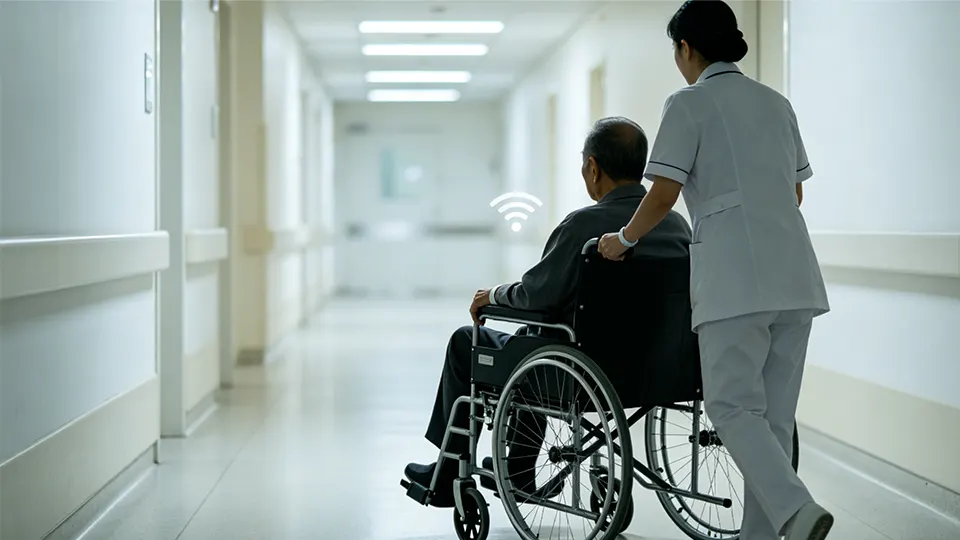
In daily operations such as ward rounds, infusion checks, or diagnostic procedures, the identification process becomes both fast and reliable. A clinician taps the NFC wristband, instantly retrieving patient information including name, medical history, allergy records, and current treatment plans.
This eliminates ambiguity and reduces the risk associated with verbal confirmation, especially in cases involving unconscious patients or language barriers.
The identity verification process generally follows a structured logic:
1. NFC wristband is scanned at the point of care
2. Patient data is retrieved in real time
3. Key identifiers are displayed for confirmation
4. Clinical actions proceed only after validation
This multi-point verification approach significantly reduces identification errors. In practice, hospitals implementing digital identification systems have reported accuracy improvements exceeding “99.8%”, compared to significantly lower rates in manual processes.
Medication administration is one of the most critical and risk-sensitive processes in hospital operations. NFC systems address this complexity by establishing a closed-loop verification mechanism that integrates patient identity, medication data, and physician orders.
Traditional workflows rely on manual adherence to safety principles such as “three checks and seven rights,” but these processes are highly dependent on human consistency. NFC introduces automated validation, ensuring that every step is verified digitally before execution.
A typical NFC-enabled medication workflow includes:
1. Scan the patient’s NFC wristband
2. Scan the medication label or NFC tag
3. System cross-checks with physician orders
4. Automatic validation of drug, dosage, timing, and route
This process ensures that mismatches are detected instantly. In controlled studies, prescribing errors have been reduced from “over 4 errors per round to less than 0.3”, while administration errors dropped by more than “60%”. In large-scale deployments, some hospitals have reported overall medication error reductions of “over 80%”, demonstrating the effectiveness of closed-loop verification systems.
In addition, NFC systems can enforce timing accuracy. For example, if a medication is scheduled at a specific interval, the system can trigger alerts when administration deviates by more than “±30 minutes”, ensuring adherence to clinical protocols.
One of the most valuable aspects of NFC systems lies in their ability to generate detailed, structured data for every clinical interaction. Each scan event is recorded with precise timestamps, operator identification, and contextual information, creating a comprehensive digital audit trail.
This level of traceability allows hospitals to reconstruct complete workflows in the event of discrepancies or incidents. It becomes possible to identify exactly when a medication was administered, who performed the action, and whether all verification steps were completed correctly.
From a management perspective, the data enables continuous performance monitoring. Hospitals can track metrics such as scanning compliance rates, medication accuracy levels, and workflow efficiency. For example, systems can automatically flag departments where compliance drops below “85%”, allowing targeted intervention.
Financial benefits are also measurable. By reducing errors, improving efficiency, and minimizing legal risks, hospitals can achieve annual savings that may exceed “hundreds of thousands of dollars”, depending on the scale of operations.

Successful implementation of an NFC system requires careful consideration of both technical and operational factors. Hospitals must ensure that the technology integrates seamlessly into existing workflows without adding complexity for clinical staff.
Wristbands must be durable, waterproof, and resistant to disinfectants, while remaining comfortable for long-term wear
System integration must support interoperability with HIS, EMR, and pharmacy systems
Staff training programs must ensure consistent and correct usage across all departments
In addition, infrastructure scalability is critical. A medium-sized hospital may manage “500 to 1,000 active patients simultaneously”, generating tens of thousands of scan events per day. The system must handle this load without performance degradation.
User behavior also plays a decisive role. Even advanced systems can fail if workflows are bypassed. Therefore, compliance monitoring and system-enforced validation steps are essential to ensure that NFC scanning becomes an integral part of daily clinical routines.
The adoption of NFC technology in hospitals represents a fundamental shift toward precision, automation, and accountability in patient care. By tightly integrating patient identification with medication verification, NFC systems establish a closed-loop safety framework that significantly reduces the risk of human error.
As healthcare continues to evolve toward digital and data-driven models, NFC-based solutions are positioned to become a standard component of hospital infrastructure. Their ability to deliver real-time validation, measurable safety improvements, and comprehensive traceability ensures long-term value not only for healthcare providers but also for patient outcomes.