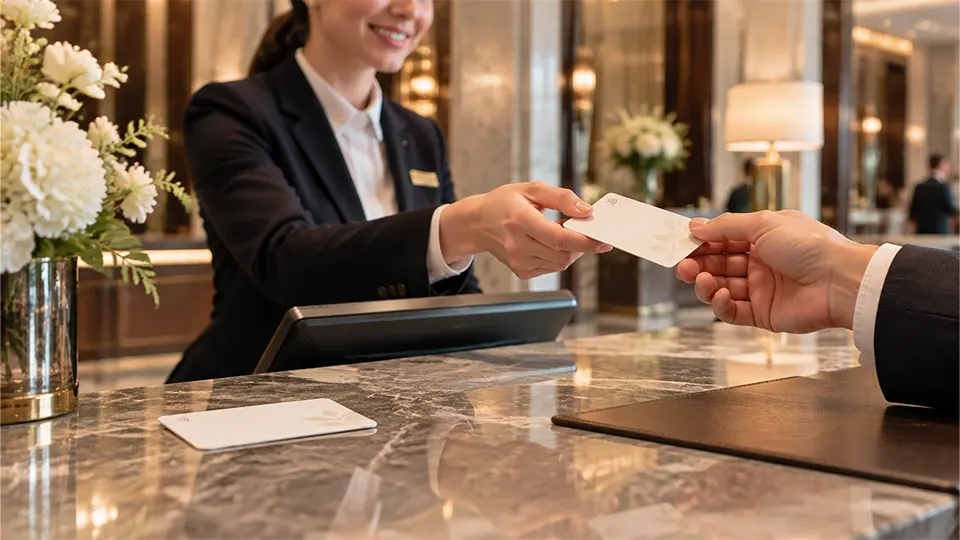
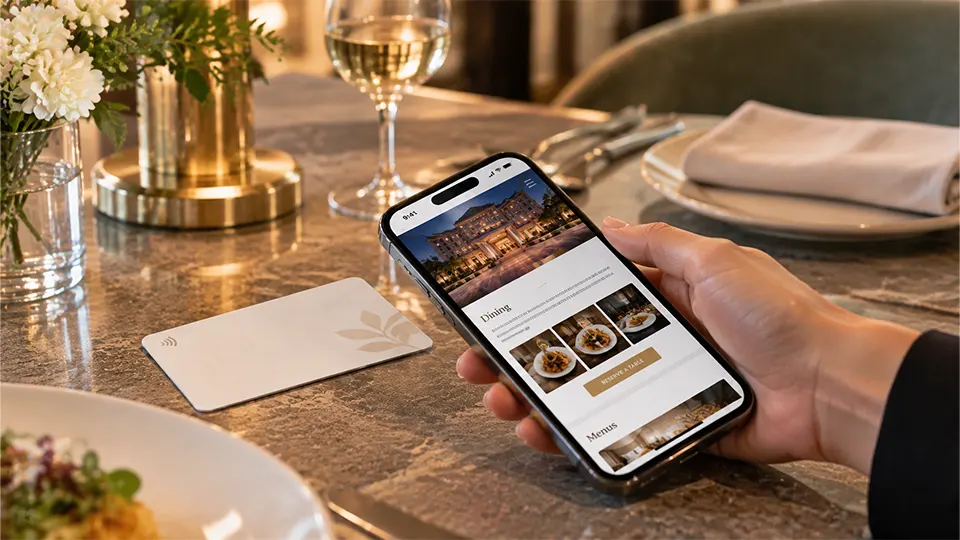
A small branded card at a hotel reception desk can serve a clear purpose: introduce the property, promote a service or direct a potential guest to a booking page. The same idea works in guest rooms, restaurants and corporate events. With NFC technology, a tap on a compatible smartphone can open the relevant webpage without requiring guests to type a URL or search through the hotel’s website.
For hotels sourcing custom NFC cards, the details that matter are often practical ones. The card must suit the property’s visual identity, work reliably with the intended smartphones and carry the correct digital destination. A boutique hotel ordering a short run of premium cards has different requirements from a hotel group supplying several thousand cards across multiple locations. Those differences should shape the specification from the outset.
Hotels already use printed materials to communicate with guests and promote services. Reception desks display property information, restaurants provide menus, and sales teams exchange contact details at trade fairs and corporate events. NFC cards add a direct connection to online content while retaining the familiarity of a physical card.
At reception, a branded card can lead prospective guests to room information, facilities or the hotel’s official booking page. In a guest room, it can open room service details, spa appointments or local recommendations. Restaurant cards can link to menus and reservation pages, while cards distributed at wedding exhibitions or travel events can introduce meeting facilities and event packages.
The destination should reflect the reason the card is being offered. A card promoting conference facilities is more useful when it opens a page with venue details, capacity information and an enquiry form. A restaurant card should take guests straight to the menu or booking page. Sending every visitor to the homepage adds an unnecessary step and makes the card less specific to the service being promoted.
NFC cards can also support partnerships with local attractions, transport providers and tour operators. A hotel can provide a dedicated card linking to selected activities without printing a separate brochure for every partner. For properties welcoming international guests, language-specific pages can serve different audiences while the physical card retains the same design.
The right card depends on the property, its facilities and how the card will be handled. A boutique hotel may prioritise a refined finish and close attention to colour reproduction. A resort with several restaurants, a spa and organised excursions may need separate cards for individual services. A hotel group, meanwhile, may prefer one approved card specification with different destinations assigned to each property.
Common applications include:
For most of these applications, the chip stores a short URL in an NDEF record. The menu, service details and booking information remain on the hotel’s website, where staff can update the content without replacing every physical card. If the destination itself needs to change, a redirect managed by the hotel can provide flexibility, provided the redirect remains active and maintained.
This distinction becomes important when cards are produced for several properties. A group might use the same artwork across its hotels but assign a different booking page, language version or local service directory to each batch. The physical product stays consistent, while the encoded destination reflects the property using it.
The design should also suit the environment. A card displayed on a restaurant table needs to withstand frequent handling and routine cleaning. A card included in a premium welcome pack may place more emphasis on surface finish and presentation. Buyers should confirm the material’s cleaning compatibility and durability with the manufacturer instead of assuming that every finish performs equally well.
PVC is a practical option for hotel NFC cards because it supports full-colour printing and familiar card formats. PET-based constructions may suit projects with specific material requirements, while wooden cards offer a different appearance for boutique properties and premium hospitality brands. The available finishes, print quality and durability depend on the particular material and manufacturing process.
Matte surfaces work well with understated branding, while foil details or spot UV can draw attention to a hotel logo. The choice should reflect both the design and the way the card will be used. A visually appealing finish is of limited value if it wears poorly under routine handling.
Chip selection is usually straightforward when the card only needs to open a webpage. NXP NTAG213, NTAG215 and NTAG216 are NFC Forum Type 2 Tag ICs compliant with ISO/IEC 14443 Type A. Their user memory capacities are 144 bytes, 504 bytes and 888 bytes respectively.
The NXP NTAG213 provides 144 bytes of user memory, which is generally sufficient for hotel NFC cards that store a short URL. NTAG215 offers 504 bytes for applications requiring more encoded data, while NTAG216 provides 888 bytes for applications with greater memory requirements. For cards designed to open hotel websites, restaurant menus or service pages, NTAG213 is often a practical choice. The higher-memory options are worth considering when the encoded data requires additional space.
For a hotel card that opens a standard webpage, NTAG213 is often sufficient. NTAG215 or NTAG216 may be appropriate when the encoded data requires more space. The extra memory does not, by itself, make a card faster to read or increase its reading distance.
The NTAG213/215/216 family operates at 13.56 MHz, with a specified data transfer rate of 106 kbit/s. NXP lists an operating distance of up to 100 mm, depending on factors such as field strength and antenna geometry. That figure describes the chip’s operating capability under suitable conditions; it is not a promise that every finished card will read at that distance. The antenna, card construction and smartphone positioning all affect actual performance.
Before approving a specification, the buyer should settle four details:
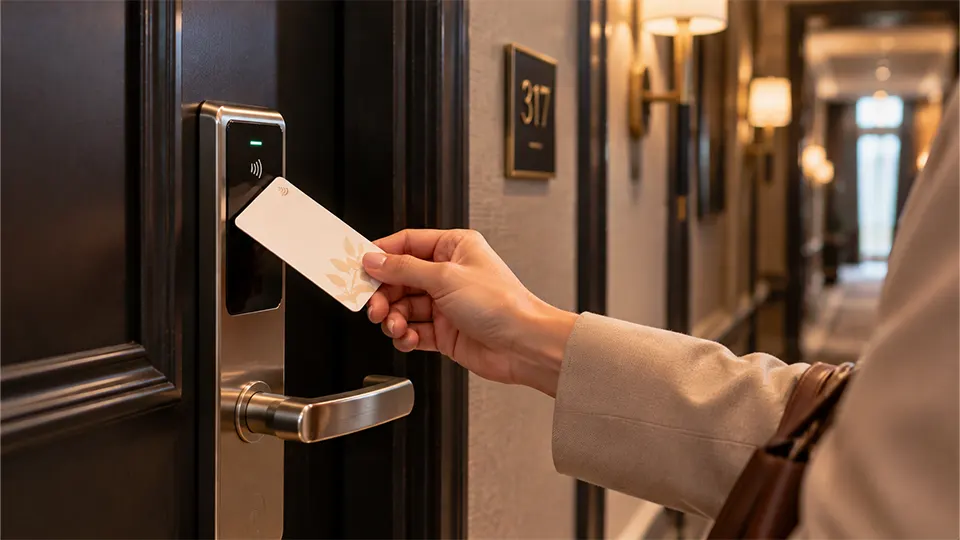
A marketing card and a hotel room key may both use contactless technology, but they have different jobs. A promotional card generally opens public digital content. A room key must work with the property’s access-control system and may depend on a particular chip technology, credential format and security configuration.
The operating frequency alone does not establish compatibility. A standard NTAG213 card should not be expected to replace an existing room key simply because both products operate at 13.56 MHz. The communication protocol, credential configuration and lock system must also match.
Hotels considering a card that combines promotional content with access functionality should confirm the requirements with their access-control provider before requesting samples. Secure access credentials require appropriate authorisation and system support; they should not be copied or modified as part of an ordinary marketing-card project.
For most promotional uses, a dedicated NFC card is simpler to specify. The hotel can print its logo and a short instruction such as “Tap for the menu”, then encode the relevant URL. Reservations, payments and account access remain on the hotel’s existing website or booking platform.
For a single property, the purchasing decision may centre on design, quantity and delivery time. For a hotel group, the specification must also cover destination management, batch consistency and repeat orders. These requirements deserve attention before production begins, particularly when several designs or language versions are involved.
Buyers should confirm the following with the manufacturer:
Encoding errors can be difficult to spot by eye. A card may have perfect printing but open the wrong webpage because a URL was assigned incorrectly. For orders covering multiple properties, each design should be linked to a documented destination and quantity. That record also helps when a hotel reorders cards months later.
A practical approval process begins with the printed sample and the agreed chip specification. The encoded card is then tested on representative smartphones, with every destination checked against the approved list. Only after the artwork, reading performance and links have been verified should the production batch be released.
NXP specifies 10 years of data retention and 100,000 write cycles for the NTAG213/215/216 family under the conditions stated in its technical documentation. These figures describe chip-level performance, not the guaranteed service life of the complete card. The card body, antenna, lamination, handling and cleaning methods also influence durability.
A manufacturer able to coordinate printing, encoding and sample validation can simplify procurement. OEM and ODM production may accommodate different brand identities, materials and destination requirements. For repeat orders, retaining the approved artwork, chip specification and encoding records helps keep later batches consistent.
Before approving a bulk shipment, the hotel should be able to confirm three things: the finished card matches the approved design, the chip reads reliably on the intended smartphones, and the encoded URL opens the correct page. That final check is particularly important when cards are distributed across multiple hotels, languages or services.