A credit-card-sized NFC key is now a familiar part of many electric vehicle access systems. It may sit alongside a smartphone digital key, Bluetooth Low Energy access or Ultra-Wideband passive entry, but its purpose is more specific. The card is a dedicated physical credential that can remain available independently of a mobile device.
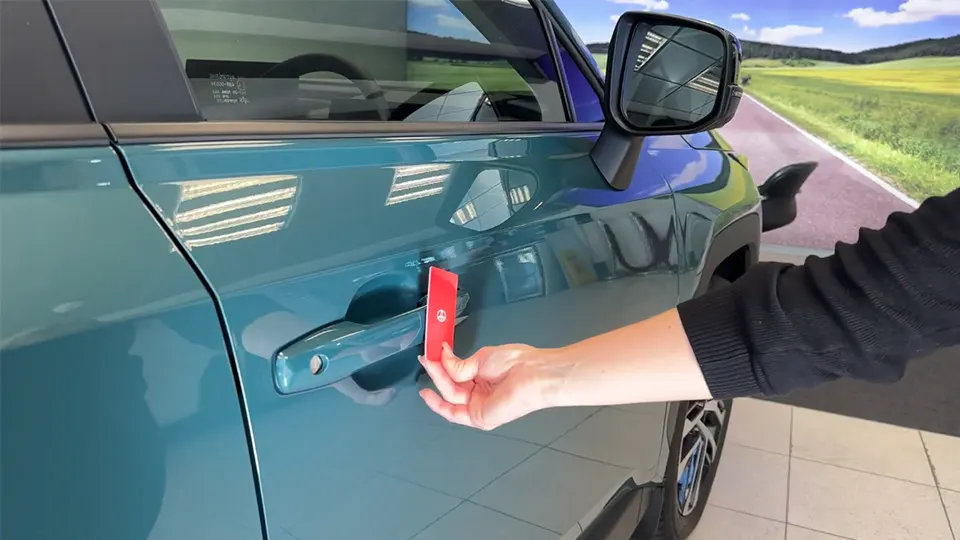
An NFC key card for an electric vehicle is used to authenticate a driver and authorize functions such as unlocking the vehicle or enabling it to start. NFC operates at 13.56 MHz and requires close proximity to the reader. The driver places the card near a designated area on the vehicle, the reader energizes the card, and the credential exchanges the information required for authentication. The card itself does not need a battery.
That operating model gives the NFC key card a clear role in a digital key system. A smartphone handles many things at once: identity, communication, applications and payments. A vehicle key card carries one purpose-built credential. It can be issued to another driver, stored as a backup or collected when access is no longer required.
For EV manufacturers and digital key platforms, the card belongs to the wider access architecture. It is one of several credentials that can be used to reach and operate the same vehicle.
UWB, BLE and NFC are often mentioned together in discussions about digital vehicle keys, although they are used in different ways.
UWB is particularly useful when the vehicle needs accurate ranging information for passive entry. BLE supports proximity communication and smartphone connectivity. NFC requires an intentional close-range action. The driver taps or presents the credential at a defined reader location.
That difference is useful in everyday vehicle access. Passive entry can be convenient when the driver approaches the car with a smartphone in a pocket. An NFC card provides a deliberate authentication action when one is needed.
Depending on the vehicle architecture, an NFC key card may be used for:
The Car Connectivity Consortium’s Digital Key framework supports a combination of technologies for this reason. NFC can handle tap-to-lock, tap-to-unlock and vehicle start, while BLE and UWB support other proximity-based interactions.
A vehicle owner may use a smartphone every day and rarely take out the NFC card. Another driver may rely on the card as a regular key. A fleet may issue cards to drivers who never need access to the vehicle manufacturer’s mobile application. The same vehicle can support several access methods without requiring every user to follow the same routine.
The usual argument for an NFC key card is that smartphones can run out of battery. That is true, although some modern devices support low-power NFC functions after the main battery is depleted. The stronger argument is that a dedicated credential operates independently of the smartphone ecosystem.
A mobile digital key can be connected to a device, operating system, user account and wallet or vehicle application. Changing phones or accounts may involve credential transfer and provisioning procedures. Those processes are manageable, but they are part of owning a multi-purpose device.
An NFC key card is simpler to define operationally. It belongs to the vehicle access system. It can be issued to a person, handed over at a counter, stored in a secure location or recovered when access ends.
A typical credential process can be organised as follows:
That structure suits several types of EV operation. A family may keep one card as a backup. A rental company can issue a card during vehicle handover. A car-sharing operator can manage credentials across a larger vehicle pool. Corporate fleets can assign access to employees without making every driver’s personal smartphone part of the same access process.
The physical format is useful here as well. The card fits naturally into a wallet or badge holder and can remain there for months without charging or maintenance.
NFC’s short operating range helps limit how the credential is presented, but range is only one part of vehicle key security. The important question is what happens after the card enters the reader’s field.
A vehicle access system needs to establish whether the credential is genuine and whether it is authorised to perform the requested action. A visible serial number or a simple card identifier is not enough for a high-security automotive credential.
Secure NFC ICs provide the building blocks for stronger authentication.
The NXP MIFARE DESFire EV3 is widely used in secure contactless credential applications. It follows ISO/IEC 14443 Type A and supports communication speeds of up to 848 kbit/s. The family includes 2 KB, 4 KB and 8 KB memory versions and supports cryptographic functions including AES-128.
The NXP NTAG 424 DNA is another secure NFC IC relevant to applications where protected interactions are required. It provides 416 bytes of user memory, supports AES-128 cryptography and includes a 128-byte protected data file. Features such as Secure Unique NFC messaging and three-pass mutual authentication can support more tightly controlled credential interactions.
Those figures describe the capabilities of the ICs, but they do not define the security of the finished vehicle key by themselves. The same chip can be part of very different systems depending on how credentials are provisioned and how cryptographic keys are managed.
A secure automotive credential program normally includes:
The NFC card, vehicle reader and backend platform need to follow the same security model. Weak credential provisioning can undermine an otherwise capable chip, while a carefully designed system can define exactly who receives access, what that person can do and when that access expires.
The chip is only one part of an automotive NFC key card. The physical construction has to survive ordinary use as well.
A card may spend years inside a wallet, pressed against other cards and carried through changing temperatures. It may be exposed to moisture, friction and repeated bending. Material selection, antenna construction and lamination quality all influence how the finished credential performs over time.
PVC remains widely used because it is economical and easy to print. PET and PETG can offer different mechanical or environmental characteristics depending on the project. Some automotive programs may also require custom constructions to meet particular durability or branding requirements.
A standard ISO/IEC 7810 ID-1 card measures 85.60 × 53.98 mm, and the familiar smart-card format is commonly around 0.76 mm thick. Within those dimensions, the antenna, chip module and card layers still need to be manufactured consistently.
NFC communication takes place at 13.56 MHz, but read performance depends on more than the operating frequency. Antenna geometry, chip matching, card materials and reader design all affect coupling. The surrounding environment matters too.
For an EV program, finished cards should be tested with the actual vehicle reader rather than only with a desktop NFC device. A reader installed behind glass, trim or an interior panel may behave differently from a laboratory test setup.
Large production runs add another requirement: consistency. An EV manufacturer or mobility platform may need thousands of cards across different markets. Variations in antenna manufacturing, chip bonding or lamination can lead to uneven read performance. Stable processes and finished-product testing are essential when the credential is part of vehicle access.
A driver should not have to guess where an NFC key card belongs.
The reader location needs to be easy to identify, particularly for backup use or for drivers who do not use the vehicle every day. The vehicle should also provide a clear indication when authentication succeeds or fails.
The same applies to vehicle start authorization. Some systems use a dedicated NFC reader inside the cabin, while others place the authentication zone in a specific console area. Access to the cabin and authorization to operate the vehicle are separate actions, and the interaction design should make that distinction clear.
A straightforward driver interaction usually follows four steps:
Permissions become especially important when several people use the same vehicle. A service technician may need temporary access. A fleet driver may require both entry and start authorization. A family member may have a permanent card with different permissions from those assigned to the vehicle owner.
For a vehicle owner, the NFC card may spend most of its life in a wallet and only come out when the phone key cannot be used. In a fleet, the same card can be an everyday operational credential. The access workflow should account for both cases.
The vehicle access architecture should come before the card design.
Project teams need to understand the reader specifications, communication protocol and authentication requirements before choosing an NFC IC or defining the physical construction. Security requirements influence chip selection, while the vehicle reader environment influences antenna design and finished-card testing.
A practical evaluation usually follows this sequence:
A standard NFC credential may be sufficient for simple identification functions. Vehicle access and start authorization require a more carefully defined security model. Secure ICs such as MIFARE DESFire EV3 and NTAG 424 DNA may be suitable where their capabilities match the architecture of the access platform.
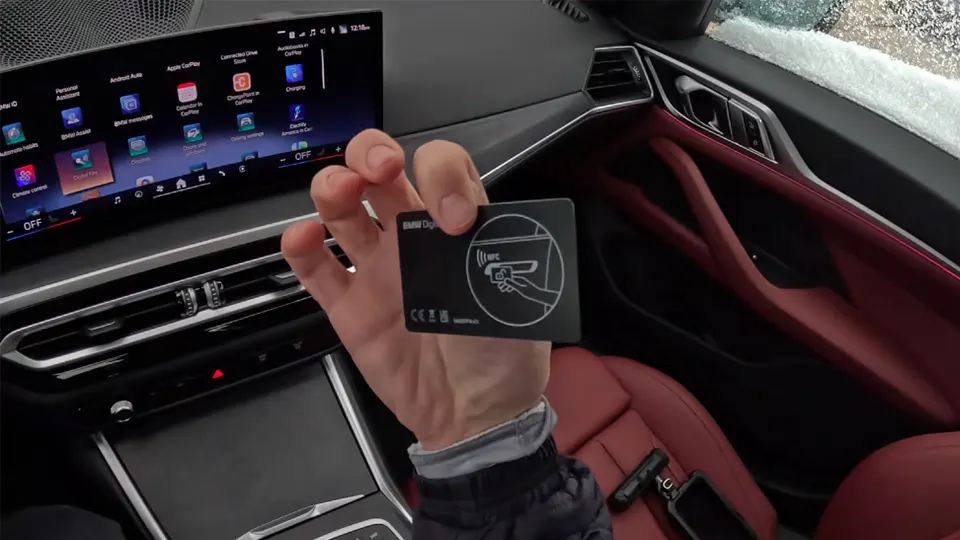
For private EV ownership, the card can provide an independent backup credential. For fleets and shared vehicles, it can become part of the daily access process. In both cases, the same questions remain important: how the credential is issued, what it is allowed to do, how it authenticates itself and how access is removed when circumstances change.
That is the practical role of the NFC key card in an electric vehicle. It remains a dedicated physical credential inside a wider digital key system—small enough to carry every day and structured enough to support controlled vehicle access.