Public transport ticketing systems rarely evolve in a clean “technology upgrade path.” In real deployments, every generation is introduced to solve a very specific operational pain point.
Paper tickets were replaced because of handling cost and fraud. Magnetic stripe systems reduced manual validation but introduced mechanical wear issues. In large metro operations, failure rates between 2% and 5% per day were not uncommon under heavy usage conditions.
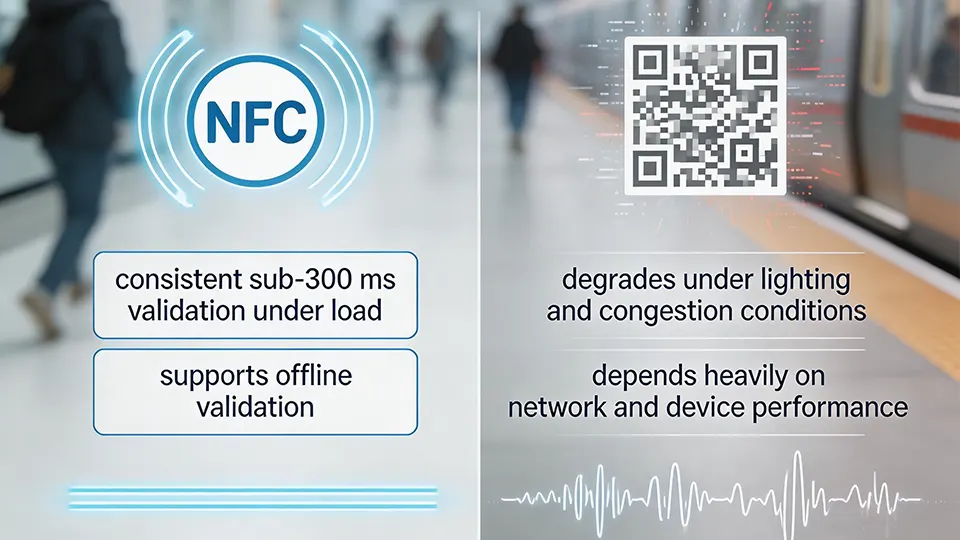
QR-based ticketing came later and looked attractive from an integration standpoint. However, field performance is often inconsistent. The issue is not generation speed, but environmental dependency—screen brightness, scanning angle, and gate congestion all directly affect throughput. In dense stations, this variability becomes a bottleneck rather than a solution.
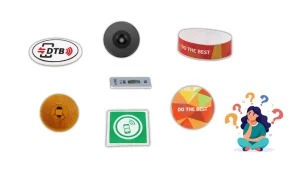
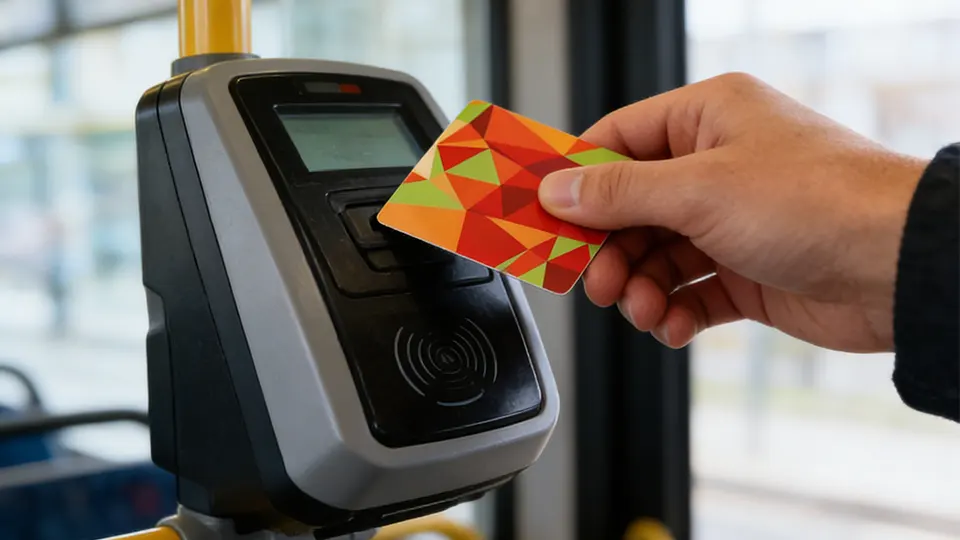
NFC ticketing became dominant not because it is “more advanced”, but because it behaves predictably under pressure (Such as the ISO card from DTB RFID). That predictability is what transit systems actually pay for.
Most NFC ticketing systems operate at 13.56 MHz under ISO/IEC 14443 Type A or Type B standards. On paper, this part is simple. In practice, the RF environment inside a metro gate is anything but controlled.
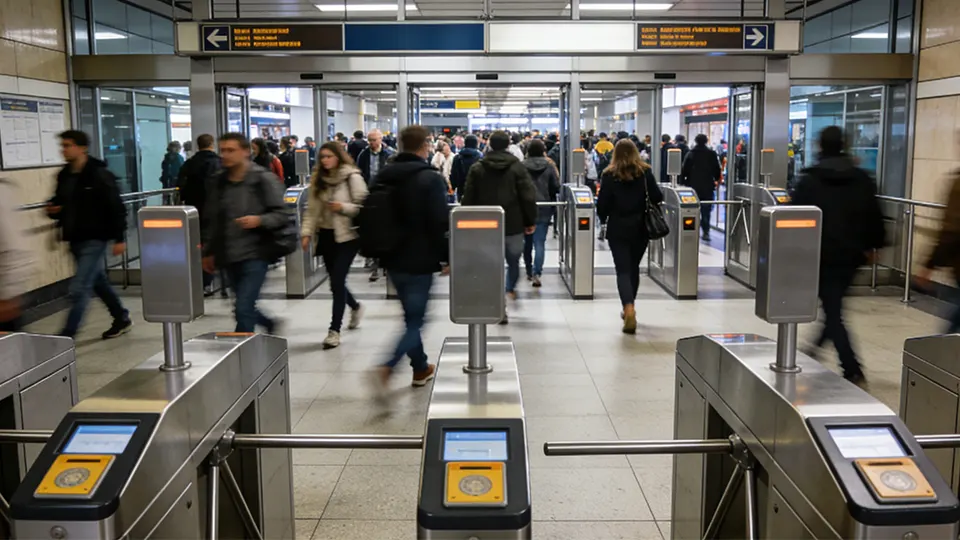
Metal frames, dense passenger flow, and multiple simultaneous card interactions create a constantly shifting coupling environment.
Common NFC reader front-end chips used in deployment include:
Each behaves slightly differently under detuned antenna conditions.
In real installations, read range is intentionally limited to around 2–4 cm. This is not a limitation—it is a design decision to avoid unintended reads in crowd conditions.
A properly tuned gate is not about maximum range. It is about repeatability under stress.
Chip selection defines the long-term stability of the entire ticketing ecosystem.
Most systems converge into a few families:
Among these, DESFire EV2 has become the practical baseline for large-scale deployments.
Its adoption is less about marketing and more about operational stability:
What matters most in real operations is not peak speed, but whether performance remains consistent after millions of cycles.
A typical NFC ticketing transaction is simple on paper, but tightly optimized in implementation.
In a standard entry/exit system, the flow usually behaves like this:
This entire cycle is expected to complete within 150–300 ms in real systems.
If it exceeds this range consistently, passenger flow breakdown becomes visible during peak hours.
Engineering decisions in NFC ticketing are almost always trade-offs rather than optimizations.
One common example is authentication depth. Stronger encryption improves security but increases transaction latency. In high-throughput metro environments, systems often prefer optimized DESFire command chaining rather than maximum cryptographic complexity.
Another trade-off is offline capability.
A typical deployment uses:
This allows the system to continue operating even when connectivity to the central server is degraded.
Theoretical throughput numbers rarely match field conditions.
In controlled lab environments, NFC transactions can complete in under 100 ms. In real stations, the observed range is typically:
The variation is mostly caused by RF collision handling and user positioning inconsistencies rather than chip speed.
Interestingly, most system bottlenecks are not in cryptography, but in RF retries.
Large-scale NFC systems are already well established globally.
Hong Kong MTR is one of the earliest large deployments of contactless transit systems at scale, handling millions of daily validations through Octopus infrastructure.
Transport for London integrates NFC-based Oyster cards alongside EMV contactless bank cards, creating a hybrid fare ecosystem that supports multiple payment sources.
Shanghai Metro operates one of the highest daily passenger loads in the world, exceeding 10 million trips per day, requiring strict optimization of gate-level NFC throughput.
These systems share a common design philosophy: stability is prioritized over feature complexity.
The comparison between NFC and QR ticketing is often simplified, but field behavior shows a clearer difference.
In dense metro environments, QR systems tend to shift congestion from gates to queues in front of scanners.
Two structural models dominate modern ticketing design:
Card-based ticketing (CBT) stores value on the card itself. It is fast, predictable, and works offline by default.
Account-based ticketing (ABT) stores value in backend systems and uses the card as an identifier.
In practice, many systems evolve toward hybrid models rather than pure ABT, mainly due to latency constraints at gate level.
ABT improves flexibility but increases backend dependency. CBT improves speed but limits dynamic pricing capabilities.
No deployment behaves exactly like the design document.
Common real-world constraints include:
Because of this, field tuning is often more important than hardware selection itself.
A system that works “well enough in lab conditions” can fail completely in a real metro station without RF recalibration.
Current NFC ticketing systems are gradually expanding beyond transit use.
Typical directions include:
The direction is not just ticketing replacement, but credential consolidation.
NFC ticketing systems are not defined by a single technology component. Their performance is the result of RF design, chip selection, system architecture, and field calibration working together under real operational pressure.
In large transit networks, success is not measured by peak performance, but by how little variance exists under stress conditions.
That is the real engineering metric behind modern NFC transport systems.