
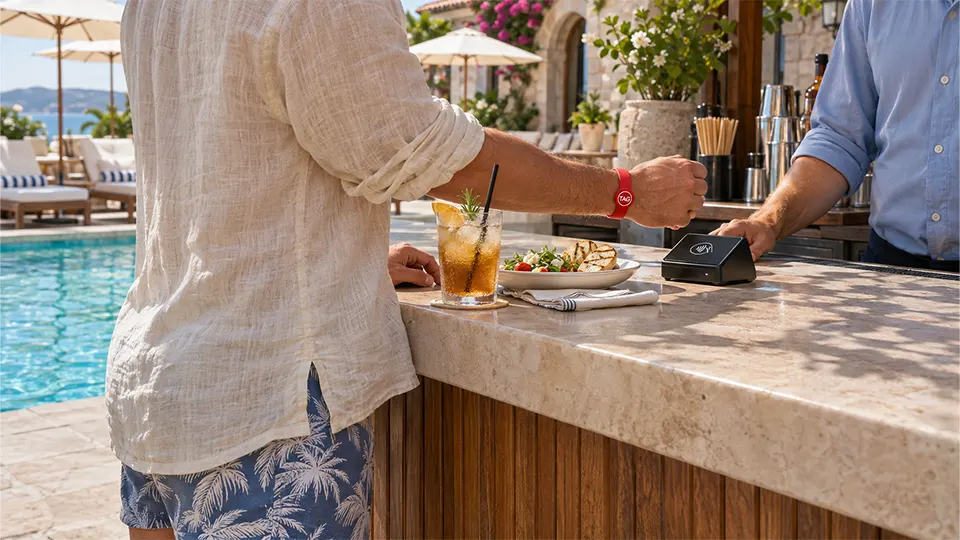
At a resort pool bar, a guest orders lunch and presents a wristband. The server needs to establish whether the meal is included, whether the guest can charge extras, and which account should receive the bill. Later, the same band may open a room or confirm admission to a booked activity.
NFC wristbands can connect these interactions through a guest credential linked to the property’s systems. The practical details sit behind the reader: room assignments, package entitlements, spending permissions and booking records. For hotel operators and integrators, specifying how those records work together is an early part of the project.
Marriott Bonvoy’s research into 2026 travel plans found that 45% of surveyed travellers across Europe, the Middle East and Africa planned an all-inclusive holiday, compared with 33% planning a resort holiday. These figures describe intentions among the surveyed travellers, rather than global booking shares. They provide context for properties managing accommodation alongside meals, drinks and leisure services.
At the restaurant entrance, the booking has to translate into a clear answer. A family may have breakfast included, a couple may have purchased a premium dining package, and day visitors may have access to selected facilities. A room upgrade can change those entitlements midway through a stay.
Wristband colours can help staff recognise broad guest categories. The terminal needs the current account record when confirming individual entitlements. After an upgrade, staff should be able to see the revised package without relying on a replacement band colour or a note passed between departments.
Guests often arrive before their rooms are available. Great Wolf’s published arrival guidance allows water park use on arrival day before suite access begins after 4 p.m. Its wristbands also serve as room keys and purchasing credentials. Facility admission and bedroom access therefore need separate activation rules.
During check-in, staff associate each band with the correct guest and reservation. Room validity, facility permissions and purchasing authority are then applied through the relevant platforms. Each family member needs an identifiable credential, even where several people share one room and bill.
A room move tests this arrangement. The old room credential must be cancelled and the new one issued, while valid meal and activity permissions remain available. Offline locks require particular attention: the integrator must explain how changes reach the lock and whether the wristband needs to be presented at an encoder or replaced.
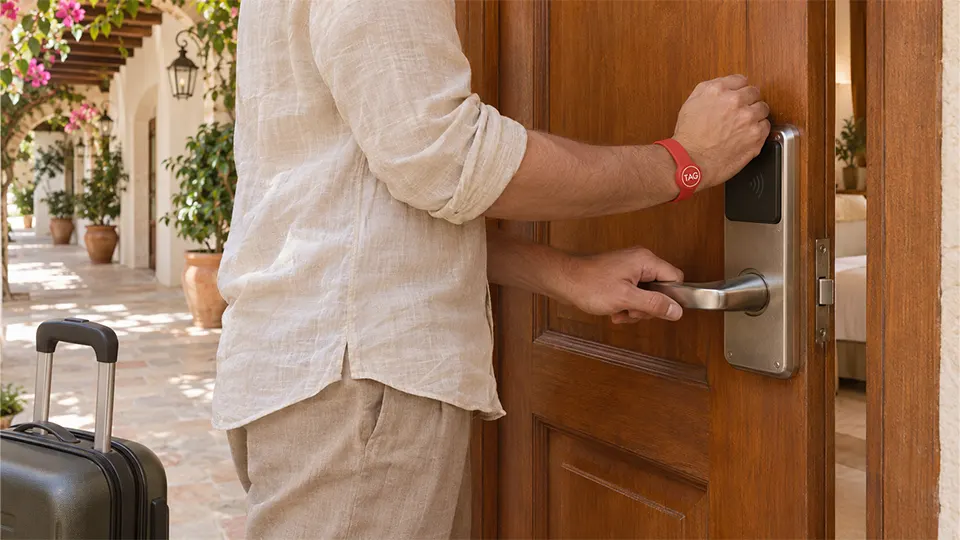
Resort wristband systems commonly use room charging, prepaid accounts or payment-network-enabled wearables. The choice affects authorisation, refunds and reconciliation. A standard NFC wristband used for room access will not automatically work as a bank card at a conventional payment terminal.
Kalahari’s Wisconsin Dells FAQ describes RFID wristbands that support room charges across restaurants, shops, the water park and spa. It specifies a $200 pre-authorisation for room charging, with unused funds returned within 3–5 business days. Great Wolf separately publishes a $100-per-night incidental authorisation. These are property-specific policies, not standard deposit amounts for wristband deployments.
For a room charge, the point-of-sale system needs an authorised account and a transaction record. The wristband supplies a credential; the connected application checks whether spending is permitted. Depending on the operating policy, a PIN or another confirmation step may be required. The receipt should retain enough information for staff to investigate a disputed purchase without exposing unnecessary guest details.
Included meals need a different transaction path. A restaurant may record an entitlement redemption without adding a charge, then bill separately for an excluded item. Finance staff need those entries clearly distinguished at checkout, alongside refunds and any outstanding authorisation holds.
A shared room account can cover people with different permissions. Parents may authorise purchases, children may have charging disabled, and a day visitor may be allowed into the pool without access to accommodation areas. Separate wristband credentials allow these rules to be applied individually where the software supports them.
Service reservations add another layer. At a spa, a tap can help staff retrieve a treatment booking and confirm whether it has been paid for. At an activity desk, it can identify the guest against an existing reservation. Capacity, appointment times and cancellation conditions remain the responsibility of the booking application.
A replacement procedure should cover every linked service. Cancelling room access alone may leave purchasing or leisure permissions active elsewhere. Staff also need an agreed response when a system is temporarily unavailable, including how to record an exception and reconcile it later.
NFC operates at 13.56 MHz. Frequency alone does not establish compatibility with a room lock, reader or software platform. Buyers need confirmation of the supported protocol, chip version, application structure and encoding arrangements. Key ownership deserves explicit agreement, particularly when several service providers share the deployment.
NXP MIFARE DESFire EV3 is a chip family used for secure, multi-application credentials. It supports ISO/IEC 14443 Type A communication and AES-128 cryptography. Whether it suits a particular property depends on the installed systems, their supported configurations and how credentials are issued and managed.
Reader procurement needs the same scrutiny. DTB RFID’s DTB-H20U handheld terminal lists HF support for ISO/IEC 14443 A/B and ISO/IEC 15693, making it a candidate for evaluation where staff need mobile credential checks. The integrator would still need to verify authentication, SDK functions and access to the relevant guest-service application before specifying it.
Physical samples should be tested while worn. A band that reads easily when held flat may behave differently on a small wrist or when presented awkwardly beside a gate. Pool-water exposure, saltwater, sunscreen, cleaning methods and closure strength also belong in the acceptance specification, with test conditions matched to the intended use.

Wallet-based room keys have received renewed attention through hospitality integrations announced in 2026. Resorts assessing mobile access still need to accommodate children, swimmers and guests who leave their phones in the room. Where phones and wristbands are both offered, staff need a consistent view of the guest’s active credentials.
A pilot should follow ordinary transactions and the interruptions that bring people back to reception. Late checkout, a lost band, an additional guest and a reversed restaurant charge can expose gaps that a successful door-opening demonstration will miss.
Record failed taps, manual overrides, replacement requests and reconciliation errors. Review repeated failures with reception and outlet staff before approving volume production. The purchase specification should preserve the agreed chip configuration, encoding process and sample-testing requirements, with a repeatable acceptance check for each delivered batch.