

NFC is often described as a “short-range, high-reliability” technology. In controlled environments, that description holds. NFC operates at 13.56 MHz, requires no internal power source in passive tags, and is widely supported by smartphones and industrial readers.
Yet in real deployments—asset tagging, access control, smart posters, or consumer interaction points—failures are not rare. Tags that worked in testing suddenly become unreadable. Read range drops from a few centimeters to almost zero. Some phones read the tag instantly, while others fail repeatedly.
In most cases, these issues are not random. They follow identifiable patterns tied to hardware design, environmental conditions, and system integration decisions. Understanding those patterns is the difference between a stable deployment and a costly rollout failure.
Before going into root causes, it helps to define what “failure” actually looks like in NFC systems. In practice, it rarely means complete destruction of the tag. More often, it shows up as inconsistent behavior.
A typical set of field observations includes:
These symptoms point to different layers of the system. Treating them as a single issue often leads to misdiagnosis.
In long-term deployments, roughly 60–70% of NFC failures can be traced back to hardware-related factors. These include chip integrity, antenna design, and physical construction.
The NFC chip itself is generally reliable, especially from established vendors. However, failures do occur under certain conditions.
Electrostatic discharge (ESD) is one of the more common causes. Even though many chips are rated for ±2 kV to ±8 kV ESD protection, improper handling during production or installation can exceed those thresholds. Once damaged, the chip may still partially function but exhibit unstable behavior.
Memory-related issues are another factor. For example, EEPROM endurance in typical NFC chips is around 100,000 write cycles. In applications involving frequent rewriting—such as dynamic URL updates or ticketing systems—this limit can be reached faster than expected.
There are also cases where configuration bits are accidentally locked. Once a memory block is locked, it becomes read-only, which can be mistaken for a failure during writing operations.
If there is one area that consistently causes problems, it is antenna design. NFC performance depends heavily on resonance at 13.56 MHz, and even small deviations can significantly affect readability.
A well-tuned NFC tag typically operates within a narrow tolerance band. A frequency shift of just ±1 MHz can reduce coupling efficiency enough to make the tag difficult to read with standard smartphones.
Several factors contribute to this:
In practical terms, a tag that is perfectly readable on a lab bench may behave very differently once deployed. For example, reducing antenna size to fit a compact label often leads to a drop in read range from 4–5 cm to 1–2 cm, even under ideal conditions.
Unlike rigid RFID cards, many NFC tags are built on flexible substrates. This introduces another failure mode: mechanical stress.
Repeated bending, pressure, or surface deformation can cause micro-fractures in the antenna trace. These fractures are often invisible but disrupt the current flow required for inductive coupling.
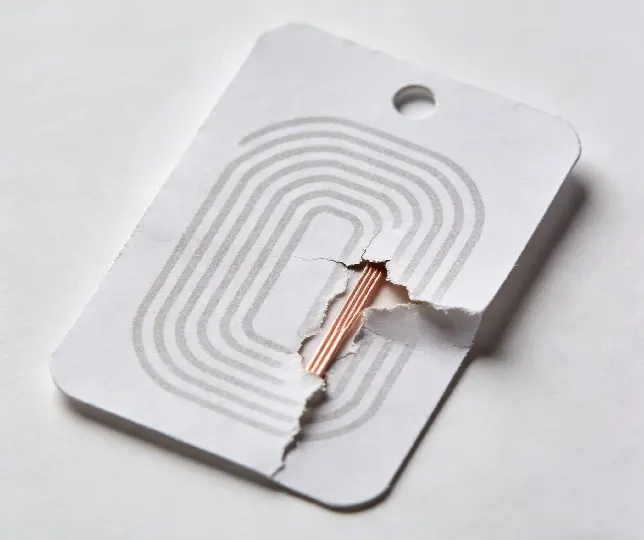
Field data from logistics and wearable applications suggests that up to 15–20% of tag failures in high-use environments are linked to physical stress rather than electronic defects.
Temperature also plays a role. Prolonged exposure above 85°C can degrade adhesives and encapsulation materials, indirectly affecting antenna performance.
Even a well-designed tag can fail when placed in the wrong environment. NFC relies on magnetic field coupling, which is sensitive to surrounding materials.
Metal is one of the most challenging environments for NFC. It does not simply block the signal—it actively distorts the magnetic field.
When a standard NFC tag is placed directly on metal, the antenna’s inductance changes, shifting its resonance frequency. In many cases, the shift is large enough to move the tag completely out of the readable range.
Measured data shows that read range can drop by over 80% when a standard label is applied to a metallic surface without isolation.
This is why anti-metal (on-metal) tags are used. These incorporate a ferrite layer that stabilizes the magnetic field. Without it, even high-quality tags will behave unpredictably.
Water and high-moisture materials absorb electromagnetic energy at 13.56 MHz. This is particularly relevant in applications involving beverages, cosmetics, or wearable devices.
For example, when an NFC wristband is worn on the human body, the effective read range can decrease by 30–50%, depending on antenna orientation and proximity to skin.

This is not a defect—it is a predictable physical effect. However, it is often overlooked during system design.
In industrial settings, NFC readers may operate near motors, power lines, or other RF-emitting devices. While NFC is relatively robust, strong electromagnetic interference can still affect communication.
Another issue arises in environments with multiple tags in close proximity. Although NFC includes anti-collision mechanisms, smartphones are not always optimized for dense tag scenarios. This can lead to inconsistent tag selection or failed reads.
Not all NFC readers are equal. In fact, variability between smartphones is one of the most underestimated factors in deployment planning.
Different phone models place their NFC antennas in different locations—top, center, or near the camera module. Output power also varies.
Measured differences in field strength between smartphone models can exceed 3 dB, which is enough to determine whether a marginal tag is readable or not.
This explains why a tag may work perfectly on one device but fail on another.
NFC tags typically follow standards such as ISO14443 or ISO15693. However, not all devices support all modes equally.
For example, some smartphones have limited support for ISO15693 (NFC-V), leading to slower reads or compatibility issues.
In addition, software layers—especially mobile apps—can introduce their own problems. Improper timeout settings, incorrect command sequences, or lack of error handling can all appear as “tag failures.”
Even with good hardware and a suitable environment, improper deployment can still cause problems.
NFC requires close proximity and proper alignment. If a tag is placed in a location where users cannot naturally align their device, failure rates increase significantly.
Field usability studies show that poor placement can increase failed read attempts by over 40%, even when the tag itself is functioning correctly.
Users are not always aware of where the NFC antenna is located on their device. Without clear guidance, they may tap the wrong area or move too quickly.
This is why successful deployments often include visual cues or instructions, even in simple applications.
Addressing NFC reliability is not about a single fix. It requires a combination of design discipline, testing, and realistic assumptions about user behavior.
Choosing the right tag for the environment is critical. This includes chip type, antenna size, and substrate material.
For example, in compact labeling scenarios, a model like DTB NFC’s DTB-L76 HF Label (from DTB RFID) is often used where space is limited, but it still requires careful placement to maintain performance.
In metal environments, anti-metal tags are not optional—they are mandatory.
Antenna tuning should not be left to chance. Prototyping and measurement are essential.
This typically involves:
Skipping this step is one of the most common causes of deployment failure.
Testing with a single smartphone model is not sufficient. At minimum, tests should include:
In practice, a tag that performs consistently across 3–5 different devices is far more likely to succeed in real-world use.
Laboratory conditions are controlled. Real environments are not.
This means accounting for:
Design margins should reflect these realities. A system that works “perfectly” at 5 cm in the lab may need to be designed for 2–3 cm effective range in practice.

Simple design choices can significantly improve success rates. Marking the NFC tap area, providing visual cues, or adding short instructions can reduce user errors.
In some deployments, these measures have reduced failed interactions by over 25%, without any hardware changes.
NFC tag failures are rarely caused by a single factor. More often, they result from a combination of small issues—slightly off-tuned antennas, marginal read power, environmental interference, and inconsistent user behavior.
What makes NFC challenging is not the technology itself, but the tight coupling between physics, hardware design, and real-world usage.
When those elements are aligned, NFC can be extremely reliable, even in demanding applications. But when they are not, failures can appear unpredictable.
From an engineering perspective, the most effective approach is systematic: understand the constraints, test under realistic conditions, and design with margin. That is what separates a working prototype from a stable deployment.