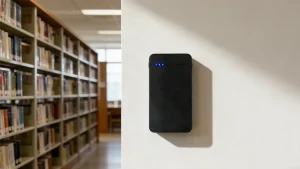

Luxury authentication in European and North American markets has shifted from visual verification to chip-level cryptographic identity systems. In high-value categories such as handbags, watches, jewelry, sneakers, and limited-edition fashion items, counterfeit penetration is commonly estimated at 8%–12% of total market volume, with significantly higher ratios in secondary resale channels where traceability is weaker and product history is fragmented.
To address this, luxury brands increasingly embed NFC-based identity chips directly into products or packaging structures, transforming authentication from a surface-level feature into a permanent digital identity layer. Once embedded, each NFC chip becomes the core identifier of a product lifecycle, linking manufacturing data, distribution routes, ownership history, and verification logs.
In real-world deployments, NFC authentication latency is typically maintained within 300–600 milliseconds, ensuring a seamless consumer experience while preserving backend cryptographic validation. Read range is generally controlled between 1 cm and 4 cm, depending on antenna design, material shielding, and device positioning.
Luxury products often require NFC integration into complex material environments such as leather, ceramic, glass, and metal components. As a result, RF tuning, ferrite shielding, and antenna geometry optimization are critical engineering requirements to ensure stable performance across different usage conditions.
Tamper resistance is also a fundamental requirement. Many luxury NFC labels are designed with structural fragility so that any attempt to remove or transfer the tag results in permanent failure. This prevents reuse of authentic tags on counterfeit goods, a known attack vector in luxury fraud systems.
A robust NFC luxury protection system must be designed around real-world attack vectors rather than theoretical encryption strength alone. Current threats in luxury authentication ecosystems can be categorized into four primary models.
Low-cost NFC tags using fixed UID or static memory structures can be duplicated using inexpensive hardware tools costing less than $5–$20 USD. These cloned tags replicate visible data but fail under cryptographic verification systems.
In systems without dynamic authentication, intercepted NFC responses can be reused to simulate valid scans. This occurs when systems lack nonce-based challenge-response validation or session-level encryption.
One of the most common luxury-specific fraud methods involves physically removing genuine NFC tags from authentic products and attaching them to counterfeit items or packaging. This bypasses surface-level verification systems if tamper detection is not implemented.
If NFC encoding occurs in unsecured environments, attackers may inject duplicated or modified identities during production or logistics stages. This results in valid-looking but unauthorized product identities entering circulation.
To mitigate these risks, modern systems rely on a three-layer security architecture:
Beyond authentication, NFC systems are increasingly used for anti-theft and anti-diversion control across luxury supply chains. Each product identity is linked to production batches, warehouse locations, and distribution channels, enabling full lifecycle traceability.
When a product is scanned outside authorized regions or distribution networks, the system can automatically flag it as a diversion risk. For example, products intended for the French market appearing repeatedly in unauthorized regions can trigger geo-based anomaly alerts.

At retail level, some luxury brands implement activation-controlled systems. Products remain in “inactive mode” until officially activated at point-of-sale. In this state, scans return limited or masked information, preventing unauthorized product exposure or pre-sale leakage.
Advanced systems also analyze scan frequency and distribution patterns. If a single product identity is detected across multiple geographic locations within a short time window, the system flags potential fraud activity. Industry deployments suggest this approach can reduce unauthorized distribution risks by 20%–35% in controlled retail environments.
The NFC chip layer defines the upper limit of system security. Luxury applications require secure ICs capable of resisting cloning, replay, and memory extraction attacks.
NXP NTAG 424 DNA is widely adopted due to its AES-128 encryption and SUN dynamic authentication system. Each scan generates a unique encrypted output that cannot be reused or replicated without backend validation.
ST25TA-E provides ECC-based security and compact integration, making it suitable for embedded luxury applications such as jewelry, watches, and hidden inlays within leather goods.
MIFARE DESFire EV3 is typically used in multi-application environments where a single NFC identity supports authentication, loyalty, warranty, and after-sales services.
Key performance standards in luxury NFC deployment include:
Luxury products typically remain in circulation for 10–20 years, requiring long-term stability in both hardware durability and cryptographic continuity.
One of the most critical components of NFC luxury protection is supply chain locking. Instead of verifying authenticity only at the consumer level, NFC identity is embedded at production stage and synchronized across ERP, MES, and logistics systems.
Large-scale luxury manufacturers can encode millions of unique NFC identities per year, each linked to material sourcing, production batch, quality inspection records, packaging time, and shipment routing data.
Once deployed, every scan becomes part of a continuous identity history, forming a closed-loop traceability system. This significantly reduces risks associated with gray-market diversion and unauthorized redistribution.
Physical anti-transfer design is also integrated into packaging architecture. Common methods include:
In advanced systems, NFC antennas are engineered to permanently fail upon removal, ensuring that authentication cannot be physically transferred between products.
The global luxury NFC protection market has transitioned into large-scale industrial deployment. Adoption rates among leading luxury brands have increased from approximately 53% to 67% in recent multi-year cycles, driven by resale growth and regulatory pressure.
More than 40 million serialized luxury products are now registered within digital identity or consortium-based authentication systems. This reflects a structural shift toward identity-based product architecture rather than traditional labeling systems.
Counterfeit luxury goods continue to generate losses estimated in the hundreds of billions of dollars annually, impacting not only revenue but also resale confidence and brand integrity. NFC authentication reduces these risks by enabling real-time verification and scan-based monitoring.
Production scale is also significant. Luxury manufacturing ecosystems now process tens of millions of NFC tags annually, particularly in apparel, footwear, and accessories segments with high seasonal turnover.
Consumer familiarity with NFC interaction has accelerated due to widespread adoption of contactless payments, especially in Europe where contactless penetration exceeds 80% in retail transactions. This behavioral normalization significantly improves adoption of NFC authentication systems.

Although Digital Product Passports (DPP) are not the core of NFC anti-counterfeiting systems, they represent an important extension layer for long-term product identity management.
In this model, NFC serves as the access gateway to a cloud-based product identity containing manufacturing data, ownership records, repair history, and sustainability information. Each product becomes a continuously updated digital asset rather than a static physical object.
Products with verified digital identity frameworks can achieve 10%–30% higher resale valuation stability due to reduced uncertainty in ownership and authenticity verification.
From a structural perspective, NFC-enabled identity systems are evolving into a unified framework:
This structure ensures that luxury goods maintain verifiable identity throughout their entire lifecycle, including resale, repair, and ownership transfer phases.
The NFC-based luxury protection system is no longer a supplementary feature but a core infrastructure layer in modern luxury commerce.
Its architecture can be summarized as:
Rather than simply digitizing luxury products, NFC technology transforms each item into a continuously verifiable identity entity, ensuring authenticity, traceability, and lifecycle integrity across global markets.