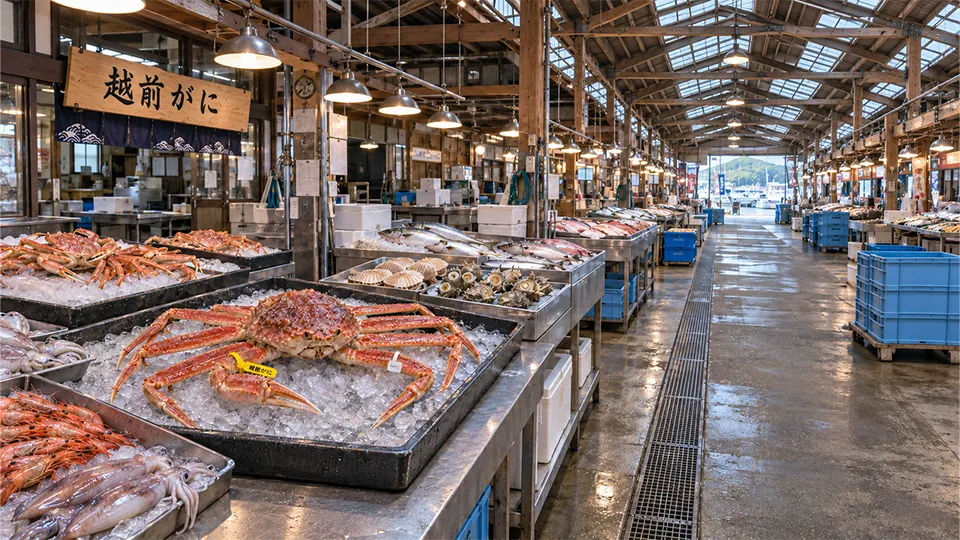
At the start of Japan’s 2026 Echizen crab season, Fukui Prefecture introduced a second way for buyers to check the origin of its larger crabs. The yellow geographical indication tag stayed on the crab. A separate chip-enabled tag gave buyers access to a page with information about the catch. The programme covered male crabs weighing at least 1.1 kg at landing, a part of the trade where a single animal can carry enough value to warrant its own record.
The new tag followed a September enforcement action over the use of the Echizen crab name on processed products. The two developments concern different points in the same supply chain. A tag attached to a whole crab can stay with it from the landing port to the buyer. Once the meat is picked and packed, the origin claim on each retail pack depends on which lots went into it and how the processor recorded them. That handover is where NFC food traceability becomes a question of production records as much as packaging.
Echizen crab was registered as a Japanese geographical indication in September 2018. The familiar yellow tag identifies qualifying crab landed in Fukui Prefecture and carries the name of the landing port. At a November 4, 2026 briefing, the prefecture confirmed that the new electronic tag would be added to qualifying large males for the season opening on November 6. Rough seas delayed the first landings by vessels belonging to the Fukui City fisheries cooperative until November 9.
The prefecture calls the new device an *IC tag*. The trade publication RFID News identified NFC as the likely technology based on the close-range smartphone interaction. The published material leaves the chip model and tag standard unspecified. From the buyer’s side, the two tags serve distinct purposes:
The 1.1 kg threshold matters to the economics of the scheme. A large crab can be handled and sold as an individual unit, so the cost of attaching a tag and associating it with a record applies to one saleable animal. A pack of picked crab meat has a different relationship to its raw material. Several crabs may contribute to one pack, and meat from one crab may end up in several packs.
The port where a crab was landed, the waters where it was caught and the place where it was processed describe different events. A port name is meaningful in the Echizen case because landing in Fukui is part of the geographical indication. A shopper reading a product page may interpret that name as a reference to the fishing grounds. An importer reading the same page may be looking for the identity of the operator or the facility that packed the product. The precision of the field names determines how much each reader can infer.
A phone tap retrieves the record associated with the tag. The provenance claim rests on where that record came from and how it was linked to the animal. A page populated from landing records has more specific evidence behind it than a page showing the same regional description for every crab. The distinction becomes particularly relevant when products from several origins reach the same packing site and leave in similar packaging.
On September 24, 2026, Japan’s Ministry of Agriculture, Forestry and Fisheries issued an order concerning misuse of the Echizen crab designation. In one case described by RFID News, more than half of the raw material in certain processed products was *mizugani*, or soft-shell crab, while the products were sold under the protected name. That finding concerned the composition and labelling of processed goods. The electronic tag introduced for large whole crabs operates earlier in the chain, while the animal and its identity are still together.
Consider a hypothetical processor receiving crab from two landing lots during a single shift. Both lots enter production, the meat is pooled and the finished packs leave under one production code. The records describe three distinct stages:
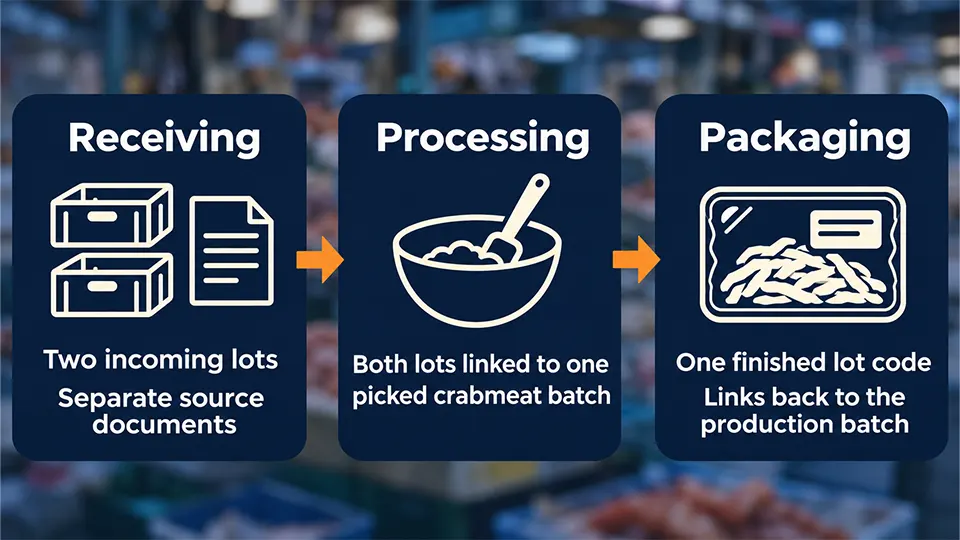
A pack from that run can be traced to both input lots when the production record preserves the link. If the meat was pooled, the record may say little about the exact share from each lot in a particular pack. Even a unique serial number on every retail pack identifies only the pack itself. Its origin record is still as granular as the production data behind it. This is why a consumer-facing traceability page and a processor’s batch record can contain different levels of detail even when both refer to the same product.
The capabilities of an NFC label depend on its chip, construction and verification service. An ordinary tag with a fixed web address can bring up a batch page. The same address can also be copied to another tag. NXP’s NTAG 424 DNA supports AES-128 cryptography and generates authentication data on a read, which a verification service can check. The NTAG 424 DNA TagTamper variant adds detection of a conductive loop that can be incorporated into a package seal. Those capabilities describe the tag and its connection to the packaging:
Physical label construction addresses a related question. DTB RFID lists the DTB-NAD30H as a 30 mm fragile HF label. A fragile face material and a monitored conductive loop are distinct design features. A fragile label can make removal evident through visible damage, while a monitored loop gives the chip a seal condition to report. The distinction matters on a jar or bottle that retains its original appearance after the contents have been replaced.
Fine wine provides a comparison. In January 2026, Identiv published a case study in which its NFC inlay was paired with wine analysis from Genuine-Analytics and a digital record from ZATAP. The analysis provided evidence about the contents associated with the bottle record. In July 2026, the U.S. Government Accountability Office also noted that technologies used to verify geographic origin generally depend on reference libraries of product samples. The quality and coverage of those samples influence what a laboratory can establish about a product’s origin.

A large whole crab, a bottle of fine wine and a carton of processed seafood may all carry an origin claim. Their packaging lines and units of sale differ, so the cost of connecting each product to its record falls in different places:
In a whole-crab programme, the recurring work sits largely at landing and handling. Someone has to associate the physical tag with the correct catch record while the animal is still identifiable. In packaged seafood, more of the work sits in the processing records, especially where a shift pools several incoming lots or one batch runs across several packaging formats. A buyer tapping a pack at retail may see the producer, packing date and listed origin in seconds. How far that record can be traced back depends on what happened on the processing floor before the pack was sealed.