
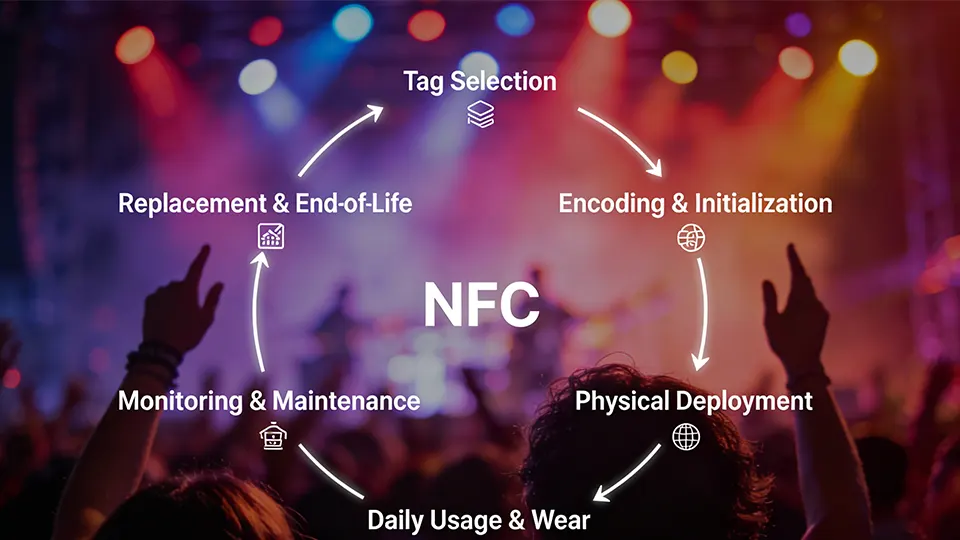
NFC technology is deeply embedded in modern contactless ecosystems, spanning event wristbands, membership cards, secure access credentials, and transportation fare systems. NFC tags act as the physical anchors that connect real‑world objects to digital systems.
Effective management of NFC tags—not merely at deployment but across their entire lifecycle—is essential for reliable, long‑term performance. Tags are often taken for granted until they fail; systematic understanding and maintenance planning can prevent read errors, premature failures, and operational disruptions that degrade user experience.
In real deployments, products like DTB NFC PVC NFC Wristbands and Fabric NFC Wristbands exemplify robust hardware used in large‑scale events and identity systems, offering durability and consistent scanning performance across thousands of taps and harsh environmental conditions.
The lifecycle of an NFC tag covers all stages from selection to retirement. It includes:
Each stage presents unique challenges and opportunities to enhance reliability and reduce total cost of ownership over time.
Selecting the right NFC tag is the foundation of lifecycle performance. Key factors include chip type, memory size, material durability, and antenna design.
Different materials offer distinct performance and durability profiles:

Chip type directly influences memory endurance:
Choosing tags matched to the environment and expected usage patterns prevents early failure and ensures stable read behavior throughout the lifecycle.
Once the hardware is selected, tags must be accurately encoded.
Encoding involves writing identifiers, application data, and access credentials to the tag memory. For events, each wristband may receive a unique ID linked to backend attendee databases. For secure access badges, tags may contain encrypted keys or authentication tokens.
Best practice includes:
Incorrect encoding often leads to read errors or security vulnerabilities in complex systems.
Deployment refers to physically placing or distributing NFC tags in the field.
Considerations include:
Poor deployment practices are among the leading causes of early tag malfunction.
Once deployed, NFC tags enter the longest and most demanding phase.
Typical daily use includes repeated taps at transit gates, access control points, or event entry scanners. Over time, mechanical stress, abrasion, and environmental exposure accumulate.
While the chip itself can often retain data for many years (some up to 10–50+ years under ideal conditions), mechanical durability and environmental resistance determine real‑world longevity.
For wearables like wristbands or ID cards stored in wallets, frequent bending and abrasion are common stressors. Choosing materials with strong encapsulation and flexible antenna designs can greatly extend service life.
Proactive monitoring is essential for long‑term reliability.
Monitoring allows organizations to:
Maintenance practices include:
Routine checks often prevent localized issues from becoming widespread operational problems.
No NFC tag lasts forever. Even rugged hardware eventually shows signs of wear.
Replacement planning differs by use case:
Planning for end‑of‑life also has environmental implications. Some organizations explore recyclable or biodegradable tag materials that minimize waste without sacrificing performance.

Key maintenance strategies that improve reliability include:
Defining hardware standards before purchasing
Conducting batch testing prior to deployment
Monitoring reader hardware and software performance
Analyzing failure patterns to pinpoint systemic issues
Implementing proactive tag replacement cycles
Selecting ruggedized tags for harsh or industrial environments
These practices transform NFC maintenance from reactive troubleshooting to proactive management.
Different applications impose specific lifecycle priorities:
Event Wristbands — Emphasis on fast scanning and cost‑effective durability over short time spans. Silicone or waterproof wristbands are common.
Membership Cards — Balance appearance and durability; PVC cards with lamination provide longer wear resistance.
Access Control Cards — Security is paramount; encrypted chips and controlled replacement schedules enhance system integrity.
Transit Payment Cards — High read frequency demands robust antenna design and high physical durability to withstand daily tapping and wallet stress.
Effective NFC lifecycle management focuses on real‑world conditions. Rather than abstract future trends, operational excellence stems from understanding how tags behave in daily use and planning accordingly. Addressing issues like wear patterns, environmental stressors, and deployment context ensures consistent performance throughout the lifecycle.
Practical experience shows that well‑planned monitoring and maintenance, starting from careful tag selection through proactive replacements, significantly reduces failures and enhances user experience. Treating NFC tags as critical infrastructure rather than disposable assets is key to delivering reliable contactless systems over years of use.
Passive NFC tags often function reliably for many years. Chip data retention can exceed 10 years under most conditions, but physical durability of the tag material often limits real‑world lifespan to 3–10+ years depending on environment and use intensity.
Most NFC tags based on chips like NTAG213, NTAG215, and NTAG216 support up to approximately 100,000 write cycles, making them suitable for rewritable applications.
Passive NFC tags do not contain batteries; they derive energy from the reader’s electromagnetic field, making them low‑maintenance and long‑lasting.
High‑quality NFC tags with IP67 or IP68 ratings resist dust, moisture, and temperature extremes. For outdoor or industrial applications, ruggedized tags significantly extend longevity.
Physical damage to the antenna, excessive bending, UV degradation, corrosion, or adhesive failure are common causes of tag malfunction. Mechanical durability typically dictates longevity more than chip lifespan.
Standard NFC tags lose performance near metal. Specialized anti‑metal or ferrite‑shielded designs provide reliable reads when mounted on metal backgrounds.