

NFC stickers rarely draw attention to themselves. They are small, thin, and usually hidden in plain sight. Most of the time, people only notice them after they’ve already used one—when a phone vibrates slightly and a page opens without any scanning or typing.
That quiet interaction explains a lot about why NFC stickers have become so common. They don’t try to replace screens or apps. Instead, they sit between physical objects and digital systems, waiting for someone to tap.
Over the past few years, as NFC became a standard feature in smartphones rather than a premium add-on, stickers turned into one of the most practical ways to deploy NFC at scale. Not because they are exciting, but because they are easy to live with.
From a technical point of view, an NFC sticker is a passive tag with an adhesive backing. There is no battery, no power source, and no signal unless a device is brought very close. That limitation often gets framed as a weakness, but in practice, it’s one of the technology’s strengths.
Close-range interaction means intent. You don’t accidentally activate an NFC sticker. You choose to tap it. In environments where trust, privacy, or accuracy matter, that small detail changes how people feel about the interaction.
Compared with printed codes or visible markers, NFC stickers feel less exposed. They can be integrated into packaging, posters, cards, or products without changing how those objects look. For designers and manufacturers, that flexibility matters more than raw technical capability.
One of the earliest and still most common uses of NFC stickers is information access. Tap a phone, open a link. That’s it.
This sounds almost trivial, but the difference lies in friction. In physical spaces—shops, exhibitions, public venues—people are rarely motivated to scan codes or type URLs. A tap feels lighter. It asks less of the user.
That’s why NFC stickers quietly replaced other solutions in places like product displays, museum exhibits, and event signage. The sticker itself doesn’t explain anything. It simply works when someone is curious enough to engage.
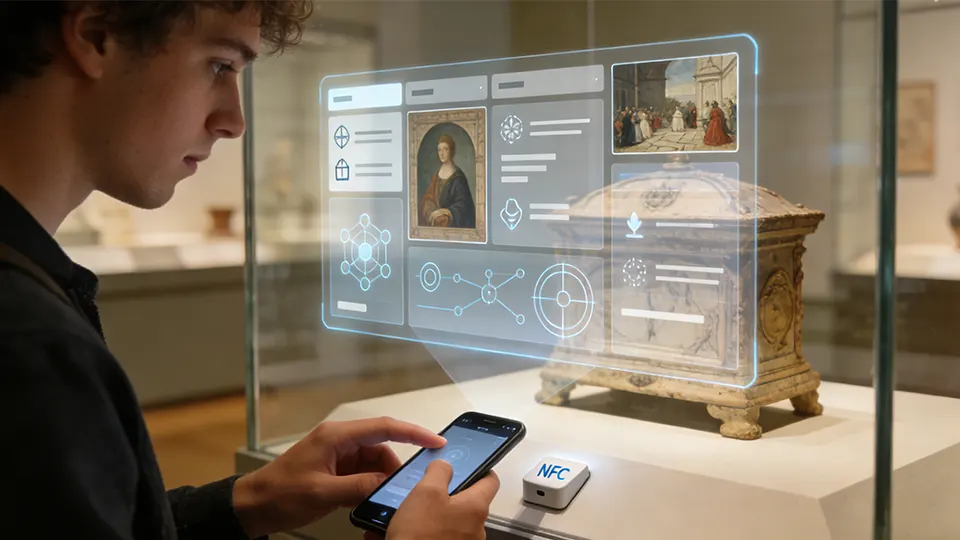
Over time, brands realized that this interaction could continue long after the first tap. The destination behind the sticker could change. Content could evolve. The physical object stayed the same, but its digital meaning did not.
Counterfeiting is often discussed as a technical problem, but it’s really a trust problem. When consumers stop believing what they see on packaging, brands lose more than sales—they lose credibility.
NFC stickers entered this space not as a silver bullet, but as a more resilient layer. Each chip carries a unique identity that cannot be copied by simply printing another label. When a product is tapped, the system can check whether that interaction makes sense in context.
For consumers, this process is invisible. They tap, and the result feels immediate. For brands, it creates a record of where and when products are being checked.
This is why NFC stickers are increasingly used on wine bottles, specialty foods, cosmetics, and health products. In these markets, the story behind the product is part of its value. NFC doesn’t tell that story by itself, but it provides a reliable way to connect the story to the physical item.
Outside consumer-facing applications, NFC stickers have become a practical tool for asset identification. Not in massive warehouses with automated systems, but in everyday environments where people still rely on spreadsheets, labels, and memory.
Attach a sticker to a laptop, a tool, or a piece of equipment, and suddenly that object has a digital reference point. Anyone with a phone can check its status, log usage, or confirm ownership.
The appeal here is not sophistication. It’s restraint. NFC stickers offer just enough structure to reduce confusion without forcing organizations to redesign their entire workflow. In many cases, that balance is exactly what’s needed.
Access systems tend to accumulate complexity over time. Cards get lost, permissions change, and temporary users become an administrative burden.
NFC stickers fit naturally into this gap. They work well for temporary access, limited credentials, and situations where flexibility matters more than durability. Stickers can be issued quickly, attached to badges or wristbands, and disabled just as easily.
For offices, shared spaces, and events, this approach reduces friction on both sides. Users don’t have to learn anything new. Administrators don’t have to manage physical inventory as closely.
Many loyalty programs fail not because they lack incentives, but because participation feels inconvenient. Cards are forgotten. Apps are ignored.
NFC stickers don’t solve loyalty by themselves, but they remove one small barrier. A tap replaces a decision. Customers don’t have to remember what to do; they just interact.
For businesses, these small interactions add up. They create a clearer picture of repeat behavior and make offline engagement measurable without turning it into a chore.
Smart packaging often promises more than it delivers. Screens, sensors, and interactive elements can feel intrusive or unnecessary.
NFC stickers take a quieter approach. They don’t demand attention. They wait.
After a purchase, a customer might tap the package to check instructions, verify authenticity, or learn more about the product’s origin. The interaction happens on the customer’s terms, not the brand’s.
This subtlety is why NFC stickers work particularly well in categories where education and reassurance matter more than promotion.
On a personal level, NFC stickers have found a niche in automation. People place them where habits already exist—by the door, on a desk, in a car.
A tap can trigger actions that would otherwise require multiple steps. The technology fades into the background, which is exactly the point.
For some users, especially those who find complex interfaces frustrating, this simplicity makes digital tools feel more approachable rather than more demanding.
In healthcare and similar environments, NFC stickers are valued for what they don’t do. They don’t broadcast signals. They don’t require constant power. They don’t interfere unless activated.
This makes them suitable for identification and tracking tasks where accuracy matters and mistakes are costly. Equipment, samples, and records can be linked to digital systems without introducing unnecessary risk.
Sustainability, Without Overpromising
NFC stickers are not inherently green, but they are evolving. Lighter materials, paper-based substrates, and reduced metal usage are becoming more common.
More importantly, NFC stickers often replace disposable materials and repeated printing. In many applications, they help reduce waste indirectly by making systems more efficient rather than more complex.
NFC Stickers and QR Codes Can Coexist
It’s tempting to frame NFC stickers as a replacement for QR codes, but that’s rarely how they are used in practice. Each has its place.
QR codes are visible, universal, and easy to create. NFC stickers are quieter, more secure, and more flexible over time. Many companies use both, letting users choose how they want to interact.
That choice itself improves the experience.
NFC stickers didn’t spread because they were flashy. They spread because they fit into existing behavior. They don’t ask users to change habits; they build on them.
As more systems move toward connecting physical objects with digital services, tools that stay simple tend to last longer. NFC stickers fall into that category.
They are not the centerpiece of digital transformation, but they often make it work.
When asked what NFC stickers are used for, the most honest answer is that they are used wherever digital interaction needs to feel natural rather than forced.
They don’t compete for attention. They wait for intent. And in a world full of screens and prompts, that restraint is exactly what makes them useful.