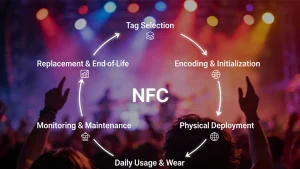
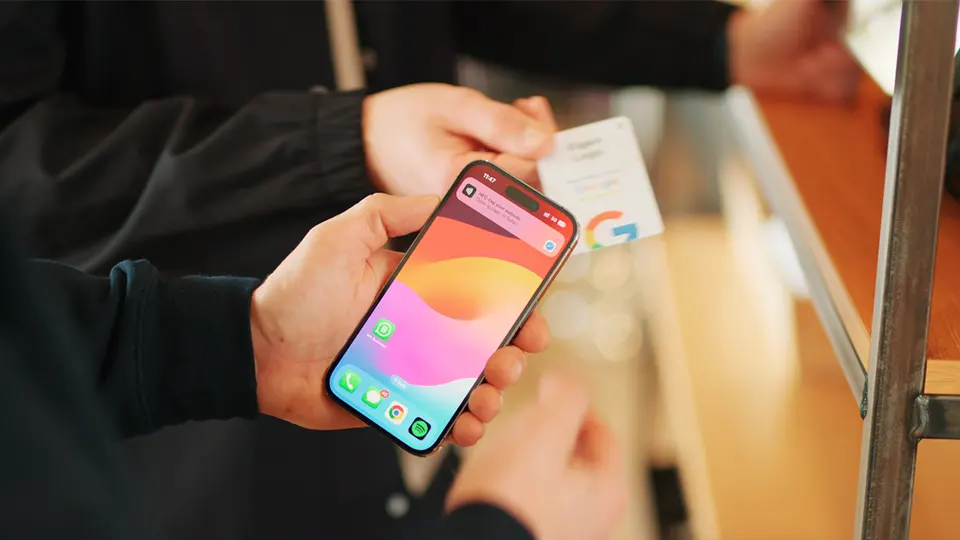
An NFC card on a restaurant counter often has one obvious job: get more customers to leave a Google Review. Tap the card, open the review page, submit the rating. It is simple enough for a customer to understand without instructions, and simple enough for staff to deploy without changing the checkout process.
That is also where many NFC card projects stop.
For businesses already using physical cards, tags, packaging, displays, or printed materials at customer touchpoints, the NFC function can do considerably more. The chip does not need to contain the entire digital experience. In a typical URL-based application, it stores an NDEF record that points the smartphone to a web address. The content sits online, where it can be managed separately from the physical card.
This small distinction has practical consequences. A card produced for a restaurant, hotel, retailer, event organizer, or professional service provider can remain in place while the page behind it changes. Google Reviews may be the first application. Menus, promotions, bookings, loyalty registration, product information, after-sales support, and digital contact details can use the same basic mechanism.
Google provides businesses with a review link that can be shared with customers and used to request reviews. Its own guidance suggests placing the link or QR code on receipts, emails, chat interactions, and printed materials.
An NFC card takes a similar destination and puts it behind a deliberate physical interaction.
That works particularly well when the customer is already standing in the right place. A hotel can place a card at reception. A restaurant can put one near the bill. A salon can position one at the checkout desk. A service business can hand a card to a customer after an appointment.
The useful part is the physical context. The customer does not have to remember a website address or search for the business again. The card is already associated with the moment when the review request makes sense.
The same card format can also point somewhere else. A restaurant may use a review page after payment but use a menu or reservation page at another touchpoint. A hotel can place different cards in guest-facing locations without changing the basic interaction: tap, open, continue.
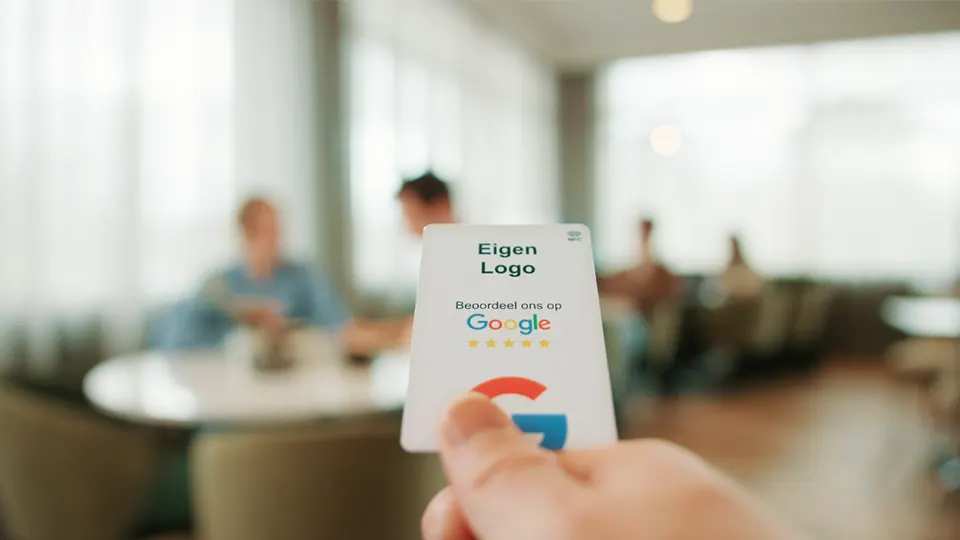
For a straightforward URL application, an NFC chip does not need a large memory capacity. NXP’s NTAG 213, for example, provides 144 bytes of user memory. NTAG 215 and NTAG 216 increase this to 504 and 888 bytes respectively. The three ICs operate at 13.56 MHz and are part of the NFC Forum Type 2 Tag family. NXP specifies up to 100,000 write cycles and 10 years of data retention for the NTAG 21x family.
For a business simply opening a web page, buying more memory does not automatically create a better customer experience.
A common misunderstanding in NFC projects is to think of the card as the place where the digital content lives.
In many customer-facing applications, the more useful structure is:
NFC card → NDEF record → URL → web content
The NFC Forum’s Type 2 Tag specification defines the technical framework used for Type 2 Tags, while NDEF provides the data format commonly used to carry a URL or other application data.
This is why a small-memory chip can be perfectly adequate for a sophisticated web experience. The card may contain little more than a URL. The website can contain photographs, product information, forms, booking functions, videos, contact details, or other content without being stored inside the NFC IC.
The important decision comes when the destination needs to change.
A fixed URL written directly to the card is appropriate when the destination is stable. A managed URL is more useful when a company expects to change campaigns, pages, or destinations after the cards have been distributed. In the latter case, the NFC card can continue pointing to the same address while the server redirects the visitor to the current page.
That difference becomes significant in larger deployments. Imagine a retailer with 50 stores and several hundred customer-facing NFC cards. If every card points directly to a campaign URL, changing the campaign may require rewriting the cards. If the cards point to a managed URL structure, the digital destination can be changed centrally.
The physical card therefore has a much longer useful life than the individual campaign printed on it.
The strongest applications tend to appear when NFC is placed at several points in the same customer journey.
Before purchase, an NFC touchpoint can provide product information, a booking page, a promotion, or a digital introduction to the brand. During the visit, it can provide a menu, service information, membership registration, or event content. After the transaction, the destination can shift toward reviews, warranty registration, support information, or loyalty programs.
Some common destinations include:
Google Reviews, menus, booking pages, loyalty registration, digital business cards, and social profiles
Product specifications, care instructions, warranty registration, user manuals, service requests, and campaign pages
The application is therefore determined less by the NFC technology itself than by the business process attached to the URL.
Consider a digital business card. The physical card does not need to store a person’s complete profile. It can carry a URL that opens a mobile-friendly contact page containing a name, company, telephone number, email address, LinkedIn profile, website, and appointment link. If the employee changes departments or contact details, the web page can be updated without producing a new card.
The same principle works for events. An NFC card distributed before an exhibition might initially open registration information. During the event, the page can display the schedule and speaker information. Afterward, the destination can be changed to presentation downloads or a follow-up contact form.
The physical object stays the same; the reason for tapping it changes.
NFC cards work best when there is already a natural physical point of contact.
Hospitality is an obvious example. Reception desks, guest rooms, restaurants, and service counters give the card a fixed location and a clear reason for interaction. Retail stores can use cards beside products, at service desks, or in promotional displays. At events, a card can sit on an exhibitor’s counter or be handed directly to a visitor.
Professional services use the format differently. A salesperson may use an NFC business card to move a conversation from a face-to-face introduction to a contact page. A consultant can direct a prospect to a portfolio or booking page. A property agent can link a card to a current listing rather than printing changing property information on the card itself.
After-sales applications are also worth separating from marketing. A card attached to a product or equipment package can open a manual, installation information, warranty registration form, maintenance instructions, or service request page.
Material selection changes with the environment. PVC is familiar for business and membership cards. Paper-based cards can suit short-term campaigns or events. Wood, epoxy, PLA, and other materials can be used when the physical appearance is part of the brand experience.
For example, the DTB-Paper NFC Card uses an NXP ICODE SLIX IC and is specified at 13.56 MHz with 1024-bit EEPROM memory. Its listed reading range is 1–3 cm, and the standard card size is 85.5 × 54 mm.
That specification also illustrates why the finished card matters more than the IC alone. Antenna construction, card material, thickness, printing, and the surrounding environment all affect how the completed product behaves.
Chip selection should follow the application rather than the other way around.
For a simple web link, an NTAG 213 can be enough. Its 144-byte user memory is more than adequate for many URL-based NDEF records. NTAG 215 and NTAG 216 provide 504 and 888 bytes when additional memory is useful.
Other applications call for different HF/NFC technologies. NXP ICODE SLIX belongs to the ISO/IEC 15693 family and is designed for applications where longer-range HF identification can be useful. It is a different proposition from a smartphone-oriented NFC business card.
MIFARE Classic EV1 1K is another established 13.56 MHz technology, with 1 KB of EEPROM memory divided into sectors and blocks. It is commonly associated with credential and access applications, where memory organization and security functions matter more than simply opening a URL.
For a customer-facing NFC card, three checks should be completed before mass production:
NFC operates at 13.56 MHz, and NFC Forum describes the technology as short-range communication, generally within a few centimeters. Actual performance varies with the smartphone, antenna design, card construction, orientation, and surrounding materials.
This is especially relevant for cards used near metal surfaces or equipment. A specification sheet for an IC cannot by itself guarantee the same behavior from every finished card construction.
The appeal of NFC cards is easy to understand when the use case is a Google Review. The customer taps, the page opens, and the purpose is immediately visible.
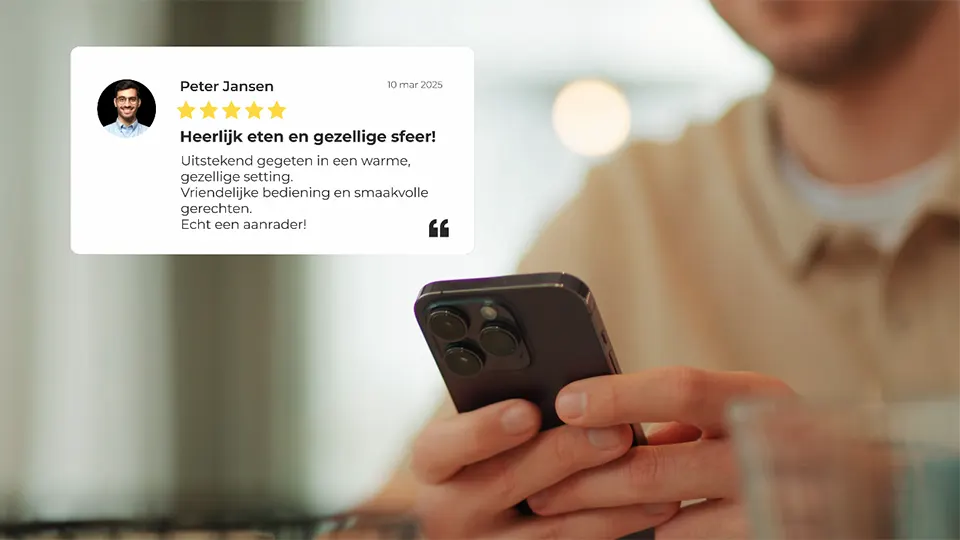
The broader value appears when the card remains useful after that particular campaign has finished.
A hotel card can move from guest information to loyalty registration. A retail card can move from a product campaign to after-sales content. A business card can continue to work after a person’s contact details change. An event card can remain useful after the venue doors close.
That is why the physical design, NFC IC, encoding method, URL structure, and digital destination deserve to be considered together. NTAG 213 may be the right choice for a simple URL. ICODE SLIX may suit a different HF identification requirement. A MIFARE Classic EV1 1K card belongs to another class of application altogether.
For brands and NFC product buyers, the useful question is therefore what the customer should reach when the phone touches the card, and how that destination will be managed six months or two years after production.
Google Reviews can be the first destination. There is no technical reason for it to be the last one.